

Investigating motor fatigue using force, EMG, and kinematic data
Description
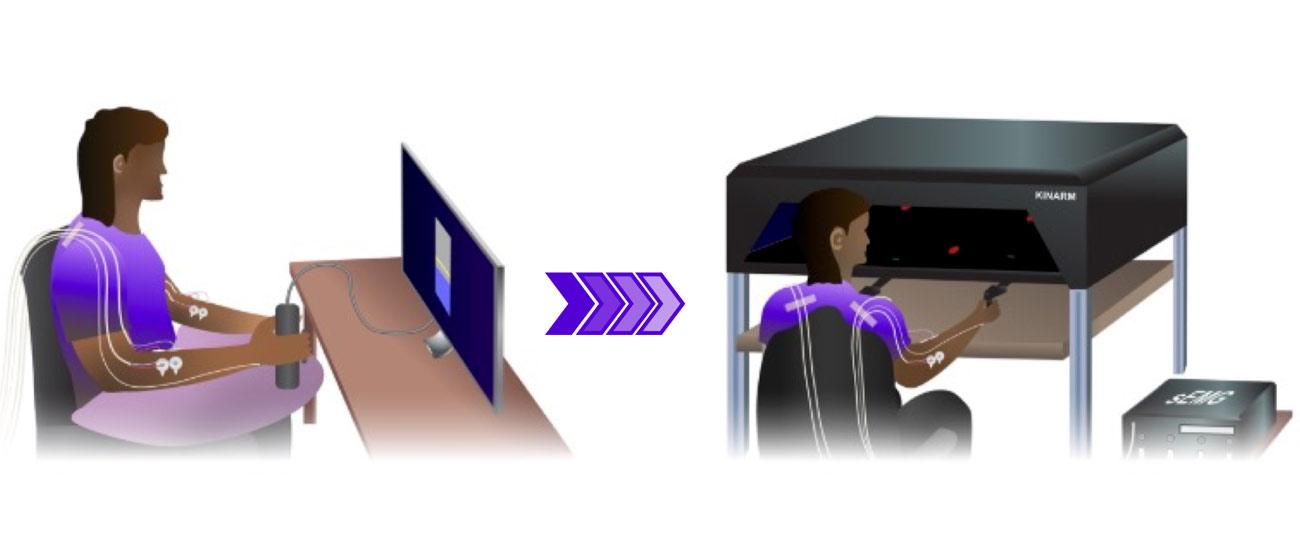
This study is a within-subject design comprising 30 subjects. Each subject performed three rounds of: Maximum Voluntary Contraction (MVC) 3×, Fatiguing Task (FT), MVC 1×, BORG-CR10, Assessment Task (AT), and a recovery period. The only difference between the three rounds was the level of force intensity (5%, 50% or 75% of MVC) during the FT.
Electromyography (EMG) of the right and left flexor carpi radialis (FCR) and extensor carpi radialis longus (ECR) muscles was acquired using bipolar configuration with a TMSi Porti7 recorder (Twente Medical Systems International B.V., Oldenzaal, The Netherlands). Small adhesive disposable electrodes with a contact area of 4.5 cm2 (Kendall H124SG; Cardinal Health, Dublin, OH, USA) were used, and placed in a bipolar setup with two electrodes placed next to each other on the bulk of the muscle belly at a fixed distance of 24 mm between the centres of the electrodes. A common grounding electrode was placed on the ulnar styloid process. EMG signals were recorded in raw format at a sampling rate of 2048 Hz and were routed through LSL and LabRecorder.
Force data were recorded using a hand dynamometer (Biopac Systems Inc., Aero Camino Goleta, CA, USA) and custom code (https://github.com/cathazi/task-Fatigue.git) implemented in MATLAB R2022a (The MathWorks Inc., Natick, MA, USA) using the Psychophysics Toolbox extensions (Psychtoolbox-3). Force data were sampled at 47.75 Hz. Dynamometer force data were routed through Lab Streaming Layer (LSL) and LabRecorder 1.16.0 (https://github.com/labstreaminglayer/App-LabRecorder/releases/tag/v1.16.0).
Kinematic data were acquired using a Kinarm End-Point Lab robot with Dexterit-E 3.9.2 software (BKIN Technologies Ltd., Kingston, ON, Canada).
For MVC Force and EMG data are available in .xdf files.
For AT Kinarm data are available in .kinarm files and EMG data are available in .xdf files.
Each subject folder contains 20 files:
SXX_calibration_MVC_1.* - mat & xdf
SXX_calibration_MVC_3.* - mat & xdf
SXX_calibration_MVC_offset.* - mat & xdf
SXX_Fat_TY_ZZ.* - mat & xdf, whereby Y could be 1,2, or 3 indicating the round, and ZZ could be 5, 50, or 75 indicating the fatigue level. Each file contains data for MVC 3, FT, and MVC 1.
SXX_Kin_Baseline.* - xdf & kinarm
SXX_Kin_TY_ZZ.* - xdf & kinarm, whereby Y could be 1,2, or 3 indicating the round, and ZZ could be 5, 50, or 75 indicating the fatigue level. Each file contains data for AT.
For details of the MVC, FT, and AT please see the preprint.
In addition, the following Questionnaire data were obtained:
AGQ-S = Achievement Goals Questionnaire for Sport
BIMAN = Bimanual Tasks in Daily Life Questionnaire
BORG = BORG-CR10 rating scale
EHI = Edinburgh Handedness Inventory
GPAQ = WHO Global Physical Activity Questionnaire
The MATLAB code used for the analysis of this dataset, as used in the preprint, is also available (https://github.com/cathazi/Knorz_2026_Fatigue).
Assistance with this dataset
We welcome researchers wishing to reuse our data to contact the creators of datasets. If you are unfamiliar with analysing the type of data we are sharing, have questions about the acquisition methodology, need additional help understanding a file format, or are interested in collaborating with us, please get in touch via email. Our current members have email addresses on our main site. The corresponding author of an associated publication, or the first or last creator of the dataset are likely to be able to assist, but in case of uncertainty on who to contact, email Ben Micklem, Research Support Manager at the MRC BNDU.
Year Published
2025
DOI
10.60964/rnd-rtyw-9w81
Metadata
Funders
Wellcome Trust (224430/Z/21/Z, 203139/Z/16/Z, 203139/A/16/Z)
Harold Hyam Wingate Foundation
Medical Research Council (MC_UU_00003)
National Institute for Health Research Oxford Biomedical Research Centre (NIHR203316)
Publisher
University of Oxford
Downloaded times
Group
Terms
Creative Commons Attribution-ShareAlike 4.0 International (CC BY-SA 4.0)
This is a human-readable summary of (and not a substitute for) the licence.
You are free to:
Share — copy and redistribute the material in any medium or format
Adapt — remix, transform, and build upon the material for any purpose, even commercially.
This licence is acceptable for Free Cultural Works. The licensor cannot revoke these freedoms as long as you follow the license terms. Under the following terms:
Attribution — You must give appropriate credit, provide a link to the license, and indicate if changes were made. You may do so in any reasonable manner, but not in any way that suggests the licensor endorses you or your use.
ShareAlike — If you remix, transform, or build upon the material, you must distribute your contributions under the same licence as the original.
No additional restrictions — You may not apply legal terms or technological measures that legally restrict others from doing anything the licence permits.