

EEG recordings in response to periodic and dithered photic stimulation (light flicker) in healthy participants
Subramaniam S, Greenway A, Duchet B
Description
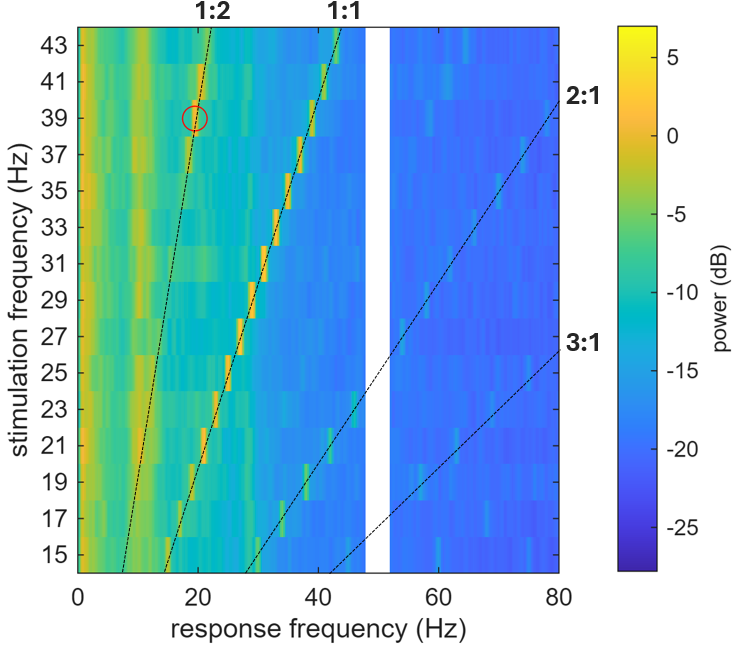
EEG recordings of n = 16 healthy participants at rest with eyes open receiving photic stimulation (light flicker) with various frequencies, inter-pulse interval variabilites (dithering level), and modulation depths. The experimental paradigm comprise two parts: 1) a frequency sweep with periodic stimulation only, and 2) comparison between periodic and dithered stimulation at various frequencies, including the individual frequency of maximum half-harmonic power response identified in the first step. For more details, please see https://doi.org/10.1016/j.brs.2026.103111
For each participant, the data corresponding to part 1 are in “PID_XX_calib.smr” (or “PID_XX_calib.mat”), and the data corresponding to part 2 are in “PID_XX_main.smr” (or “PID_XX_main.mat”). Recordings include 15 EEG channels and the synchronised photodiode signal capturing stimulation pulses. In the .mat files, these 16 signals are in the variable “SmrData.WvData”, and the corresponding channel names in “SmrData.WvTits”.
The matlab scripts “all_participants_calib.m” and “all_participants_main.m” (and associated functions) demonstrates how to load the EEG data (and synchronised photodiode output) in the .mat format, and segment trials corresponding to parts 1 and 2 of the experiment, respectively. These scripts also describe how to obtain the stimulation conditions corresponding to each trial, and can plot the photodiode signal and associated statistics for each trial. The correspondence between stimulation condition and randomised trial number is given in the text files “PID_XX_calib.txt” and “PID_XX_main.txt”, but also directly included in the scripts “all_participants_calib.m” and “all_participants_main.m” for convenience (see variable “condOrder”).
Assistance with this dataset
We welcome researchers wishing to reuse our data to contact the creators of datasets. If you are unfamiliar with analysing the type of data we are sharing, have questions about the acquisition methodology, need additional help understanding a file format, or are interested in collaborating with us, please get in touch via email. Our current members have email addresses on our main site. The corresponding author of an associated publication, or the first or last creator of the dataset are likely to be able to assist, but in case of uncertainty on who to contact, email Ben Micklem, Research Support Manager at the MRC BNDU.
Year Published
2026
Copyright Years
2024-2026
DOI
10.60964/rnd-e9mr-v731
Metadata
Funders
Royal Academy of Engineering
Rosetrees Trust
Publisher
University of Oxford
Downloaded times
Group
Terms
Creative Commons Attribution-ShareAlike 4.0 International (CC BY-SA 4.0)
This is a human-readable summary of (and not a substitute for) the licence.
You are free to:
Share — copy and redistribute the material in any medium or format
Adapt — remix, transform, and build upon the material for any purpose, even commercially.
This licence is acceptable for Free Cultural Works. The licensor cannot revoke these freedoms as long as you follow the license terms. Under the following terms:
Attribution — You must give appropriate credit, provide a link to the license, and indicate if changes were made. You may do so in any reasonable manner, but not in any way that suggests the licensor endorses you or your use.
ShareAlike — If you remix, transform, or build upon the material, you must distribute your contributions under the same licence as the original.
No additional restrictions — You may not apply legal terms or technological measures that legally restrict others from doing anything the licence permits.